


 Sep 23, 2026
 View:12
Rakeable Aluminium Fencing for Australian Sloping Sites
A sloping block can turn a simple fence run into a difficult installation. Standard rigid panels often have to be stepped, leaving triangular openings underneath. Closing them with plinths, sleepers or retaining work adds labour, materials and coordination.
Princeton Metal rakeable aluminium fence panels follow the site gradient while keeping the posts and pickets vertical.You gain a cleaner fence line, fewer unwanted openings and greater installation flexibility across changing levels.
If you are a fencing contractor, builder or developer, your priority is making sure the panels, posts, gates and mounting details work together before delivery. Explore our aluminium boundary and frontage systems, or send us your slope measurements for a project review.
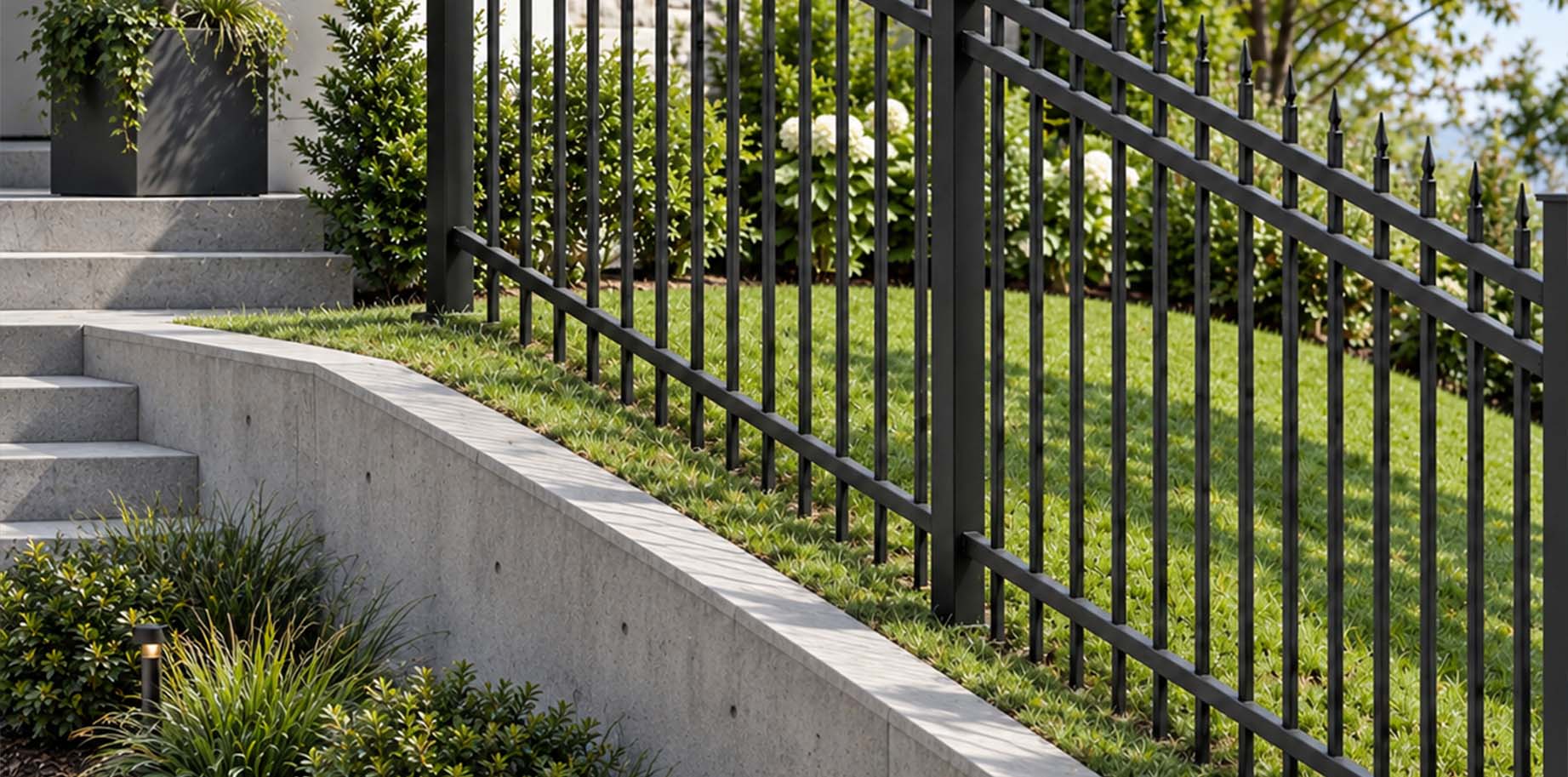
1.Why Sloping Fence Projects Become Difficult
Changing ground levels affect your post lengths, panel positions, ground clearance, gates and transitions. If these details are missed before ordering, you may face relocated posts, modified panels or delays while waiting for replacement parts.
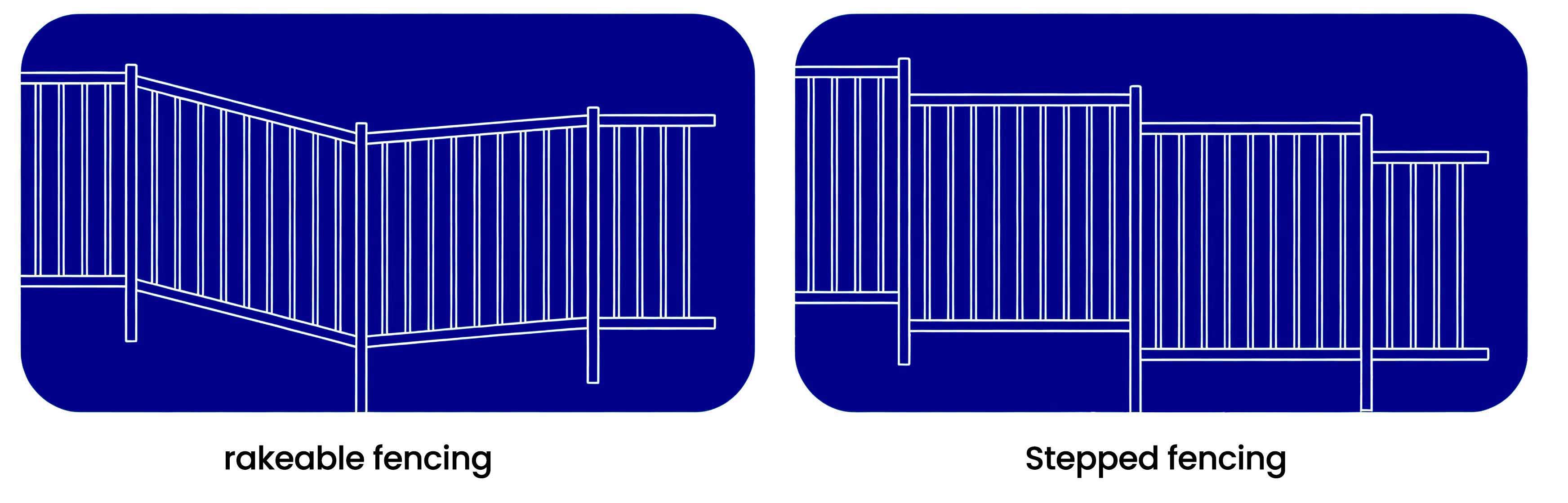
Stepped fencing keeps panels horizontal but may leave an opening below each section. This can affect appearance, pet containment and required ground clearance. Plinths or retaining structures can close the openings, but add work and cost.
Rakeable fencing follows the general fall of the land. It can reduce triangular gaps without requiring the entire fence line to sit on level platforms.Sharp drops, drains and retaining walls may still need a stepped or custom transition.
Your practical design may combine standard panels on level ground, rakeable panels on consistent slopes and short or stepped sections at abrupt changes. Resolving this panel mix early gives you a clearer overall installed-cost picture and leaves your installer with fewer surprises when work begins.
2.How Rakeable Aluminium Fence Panels Work
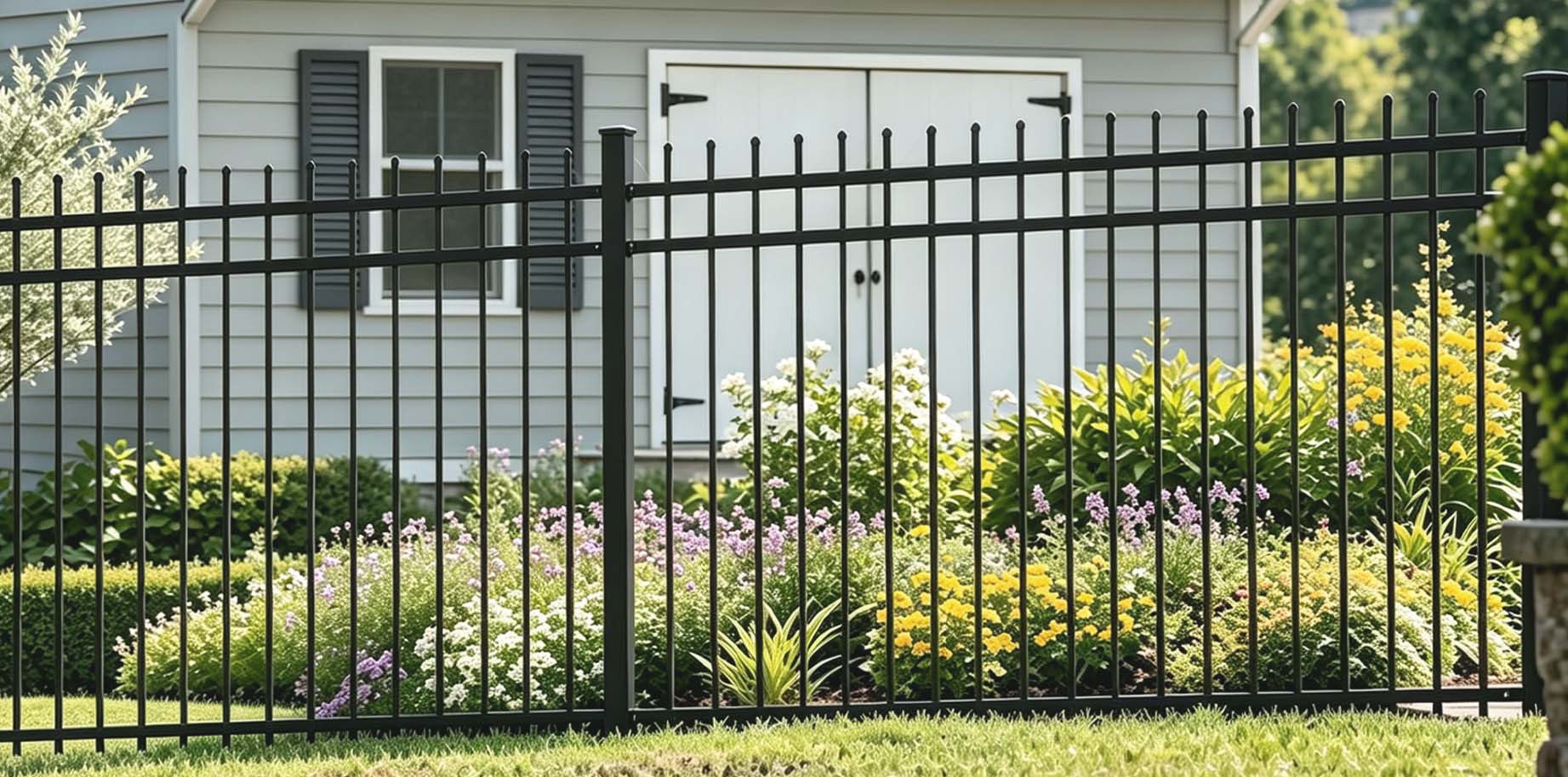
A rakeable panel changes from a rectangle into a parallelogram. The horizontal rails follow the slope while the posts and pickets remain plumb. This allows the fence to follow the terrain instead of stepping up or down at every post.
During installation, the posts are positioned and the panel is adjusted to match the measured rise and run between them. Depending on the chosen system, the final bay may also be shortened and completed with suitable brackets and end treatment.
The available rake depends on panel width, height, picket spacing, rail geometry and connection design. The correct rake range must be confirmed for the selected panel configuration, rather than applied as one universal angle.
Princeton Metal can review the slope before production and identify where standard panels, rakeable panels, short spans or different post arrangements are required. Our design and manufacturing capabilitiessupport project-specific coordination, while the Technical Resource Hub provides access to drawings, compliance documents and installation references.
3.Why Choose Rakeable Fencing Instead of Stepped Panels
If your boundary has a gradual or consistent slope, rakeable fencing is usually the more practical and visually complete solution.Rather than forcing horizontal panels onto sloping ground, the fence follows the grade and maintains a continuous line from one section to the next.
| What matters to your project | Rakeable Fencing | Stepped Fencing |
| Finished appearance | Smooth, continuous line that follows the slope | Visible staircase effect between panels |
| Openings below panels | Reduces large triangular gaps | Often leaves gaps that need closing |
| Extra materials | Can reduce the need for plinths or sleepers used only to close gaps | May require additional gap-filling materials |
| Site flexibility | Adjusts to the measured grade within the engineered range | Limited to horizontal panels and fixed step heights |
| Installation planning | Standard, raked and short spans can be coordinated | Extra post length and gap treatment must be planned |
For your project, this can mean a cleaner result, fewer gap-closing details and less remedial work on site. The vertical pickets preserve the intended appearance while the rails adapt to the slope.
Stepped panels may still be needed at abrupt drops or on level retaining-wall platforms. Using rakeable panels across the main sloping runs limits stepped sections to where they are genuinely necessary and helps avoid incorrect posts or improvised cuts.
If your fence includes pedestrian or vehicle access, Princeton Metal can coordinate the adjoining panel layout with our aluminium gates and access systems.
4.What You Should Check Before Ordering
Panel price is only one part of the installed cost. On a sloping site, the more expensive problems are often incorrect measurements, unsuitable panel geometry, missing brackets or a gate position that conflicts with the finished ground level.
Before ordering rakeable aluminium fencing, confirm:
(1)the rake range for the actual panel width and height;
(2)post, rail and picket profiles;
(3)picket spacing and required ground clearance;
(4)mounting conditions, including soil, concrete and retaining walls;
(5)gate location and operating clearance;
(6)powder-coating specification and exposure conditions;
(7)whether panels can be shortened safely on site;
(8)availability of replacement panels and hardware.
Aluminium is lightweight, corrosion-resistant and does not rot like timber, but performance still depends on material grade, connections, surface preparation, coating and fasteners.
For your pool project, compliance applies to the complete installed barrier—not the panel alone. You need to assess height, openings, clearance, gates, latches and non-climbable zones. Review our aluminium systems for pool areas, then have your final design confirmed by your installer and relevant local certifier.
5.How Princeton Metal Helps Reduce Installation Risk
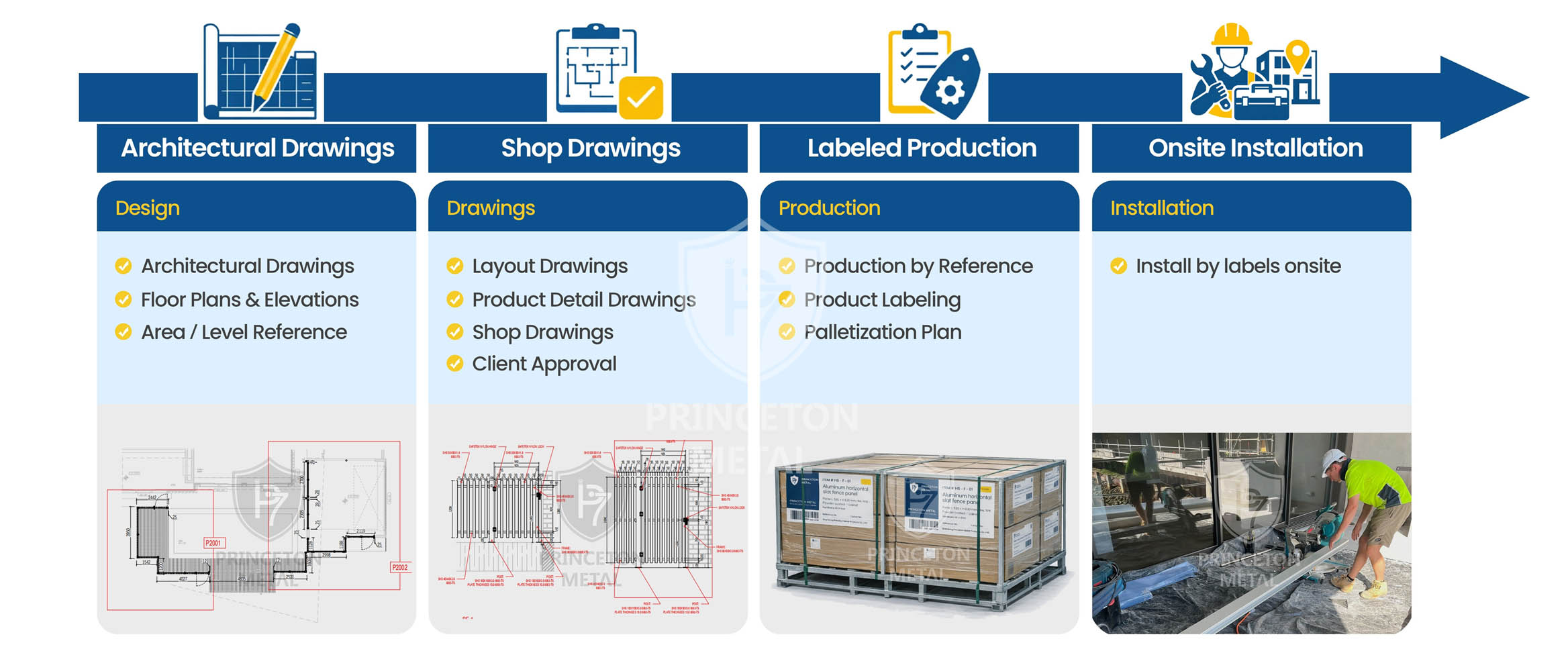
Princeton Metal helps turn site information into an organised fence package rather than supplying unrelated panels and fittings.
(1)Layout and BOM coordination:Panels, posts, brackets, gate hardware and finishing components are matched to the agreed fence runs.
(2)Slope and transition planning:Standard panels, rakeable sections, short bays, wall connections and stepped transitions are considered together.
(3)Post and gate options:Mounting conditions, gate clearances and adjoining panels are reviewed before the material schedule is finalised.
(4)Installation-zone packaging: Components can be organised by facade or fence run so crews can identify the correct materials on site.
(5)Replaceable components:Panels, posts, rails and gate hardware can be replaced individually when maintenance is required.
These steps help you avoid incorrect quantities, last-span problems, unnecessary cutting, missing hardware and delayed replacement materials. You receive an installation-ready package—not simply a collection of fence panels.
You can also view Princeton Metal’s Australian and international project experience, including residential and commercial projects involving coordinated fences, gates, screens and other aluminium systems.
6.What We Need for a Layout, BOM and Quote
Accurate site information allows us to assess the fence before production. The key measurements are the rise and run of each sloping section. Rise is the vertical change in level; run is the horizontal distance over which that change occurs.
Please provide:
(1)Total fence length and each sloping section;
(2)Rise and run for each slope;
(3)Required fence height, style and colour;
(4)Gate quantity, opening width and location;
(5)Mounting condition: soil, concrete, retaining wall or wall fixing;
(6)Project postcode and required delivery date;
(7)Pool or non-pool application;
(8)Plans, sketches or clear site photographs.
If the ground changes several times, divide the boundary into separate measured sections. You do not need a complete architectural drawing to begin—a dimensioned sketch and clear photos are enough for an initial review.
We will assess where you need standard, rakeable, stepped or short-span panels and identify any missing information before production. You receive a more reliable quotation and a clearer basis for planning posts, panels, gates and transitions.
Tel:0086-17616763451
WhatsApp:+86-17616763451
Email:sales@princetonmetal.com
Factory Address:NO.2788, Nanhuan Road, Linqu County, Weifang City, Shandong Province, China, 262600
Sources and Further Reading:
Diamond Fence — Practical guidance on fencing techniques for sloped ground
https://www.diamondfence.com.au/uphill-battle-not-anymore-fencing-techniques-for-sloped-ground/
On The Fencing — Overview of fencing options for sloped or uneven blocks in Melbourne
https://onthefencing.com.au/best-fencing-options-for-sloped-or-uneven-blocks-in-melbourne
Doogood Australia — Product information and technical overview of rakeable fencing panels
https://www.doogoodaustralia.com.au/rakeable-fencing-panels
Bunnings — Product reference for the ProtectorAl raked flat-top garden fence panel
https://www.bunnings.com.au/protectoral-1201-2400-x-900mm-black-satin-raked-16-30-flat-top-garden-fence-panel_p0639236
Standards Australia — Official information about Australian Standards and their application
https://www.standards.org.au/