


Why Standard Powder Coating Fails on Coastal Aluminium Fencing: Specifying AS 3715 & AAMA 2604 for C4/C5 Environments
 Oct 27, 2026|
 View:2
For Australian architects, facade engineers, and building contractors, specifying exterior architectural aluminium along the coastline carries high liability. Whether you are installing screening louvres in Queensland, sunshade battens in Sydney, or custom architectural aluminium systems in Perth, Australia's marine climate is unforgiving.
Two years after handover, substandard powder-coated louvres begin to blister, cut edges develop white corrosion, and colours like Monument® or Satin Black turn chalky. When clients demand remediation, standard offshore warranties vanish behind fine-print "marine exclusions," leaving you facing tens of thousands of dollars in scaffolding and replacement costs.
Why does standard powder coating fail so quickly on Australian coasts, and how can you protect your projects? The answer lies in looking beyond film thickness and specifying a true marine-grade system under AS 4312, AS 3715, and AAMA 2604.
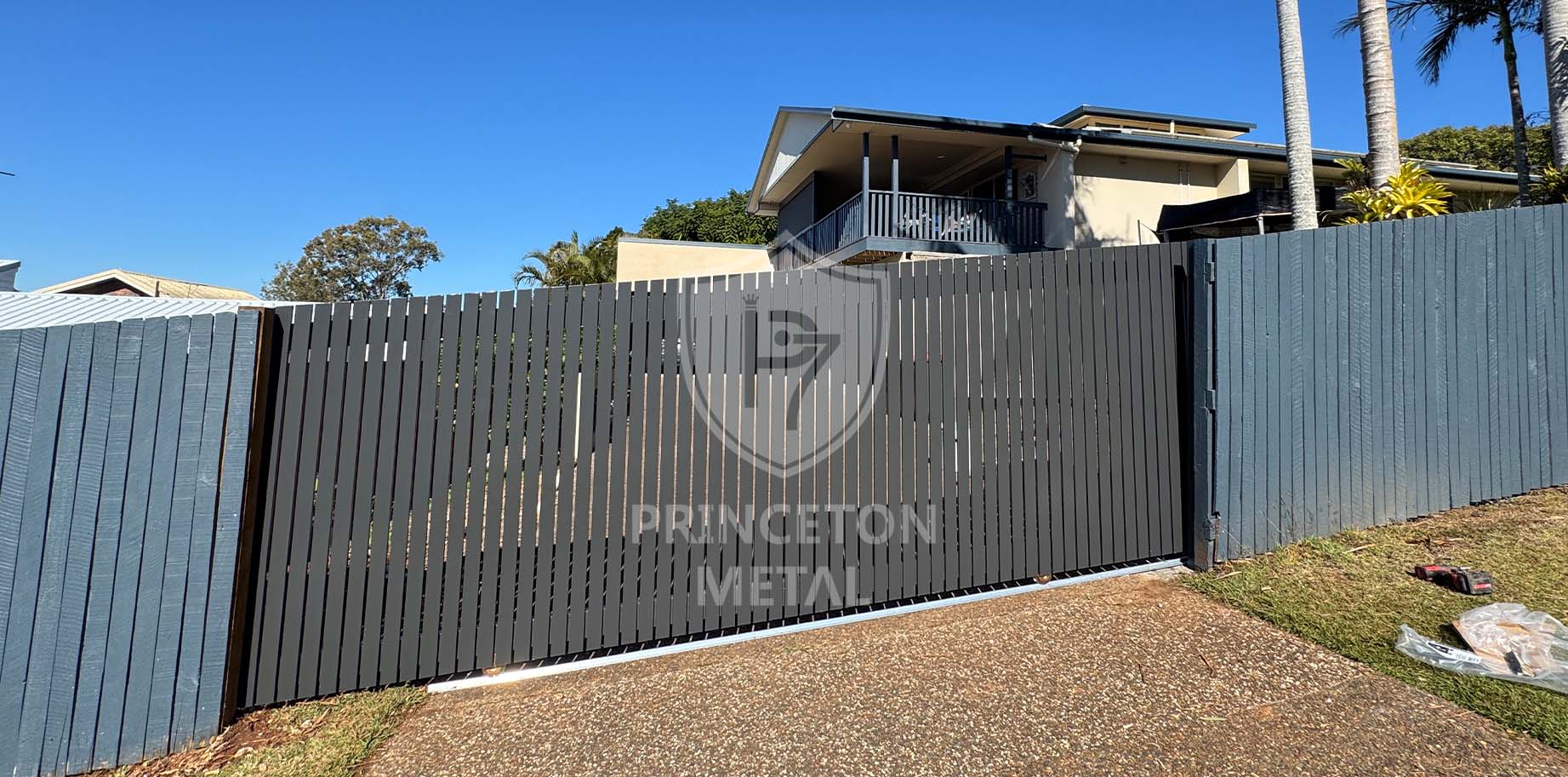
1. The Australian Coastline Reality: Why Standard 50–60µm Coatings Fail
Over 85% of Australia’s population lives within 50 kilometres of the ocean. In Greater Brisbane, Moreton Bay, the Gold Coast, and coastal Sydney, oceanic winds carry salt particles several kilometres inland.
Standard fabricators typically supply basic polyester (meeting only basic AAMA 2603 with 50–60 µm thickness). Within 1 to 5 kilometres of open sea—classified under AS 4312 as C4 (High Corrosivity) or C5-M (Very High Marine)—this coating fails rapidly.
The Filiform Corrosion Trap
The primary failure mode on coastal louvres and screens is filiform corrosion:
(1)Entry Point: Cutting, punching, or perforating aluminium profiles exposes raw metal.
(2)Electrolyte Formation: Humidity and dew dissolve salt crystals, creating an aggressive chloride electrolyte.
(3)Corrosion Creep: Moisture penetrates microscopic fissures along raw edges, migrating beneath the paint film.
(4)Surface Blistering: Thread-like corrosion tunnels force the finish to bubble and peel away.
Once filiform corrosion begins, on-site repair is impossible—requiring complete profile replacement.
2. Why Thickness Alone Won’t Save Your Facade: The Three-Pillar Defense
Believing that simply requesting "thicker paint" (e.g., 80 or 100 µm) stops coastal corrosion is a costly mistake. Spraying 100 µm of standard polyester over poorly prepared metal still delaminates within 36 months.
True coastal durability requires an integrated Three-Pillar Defense:
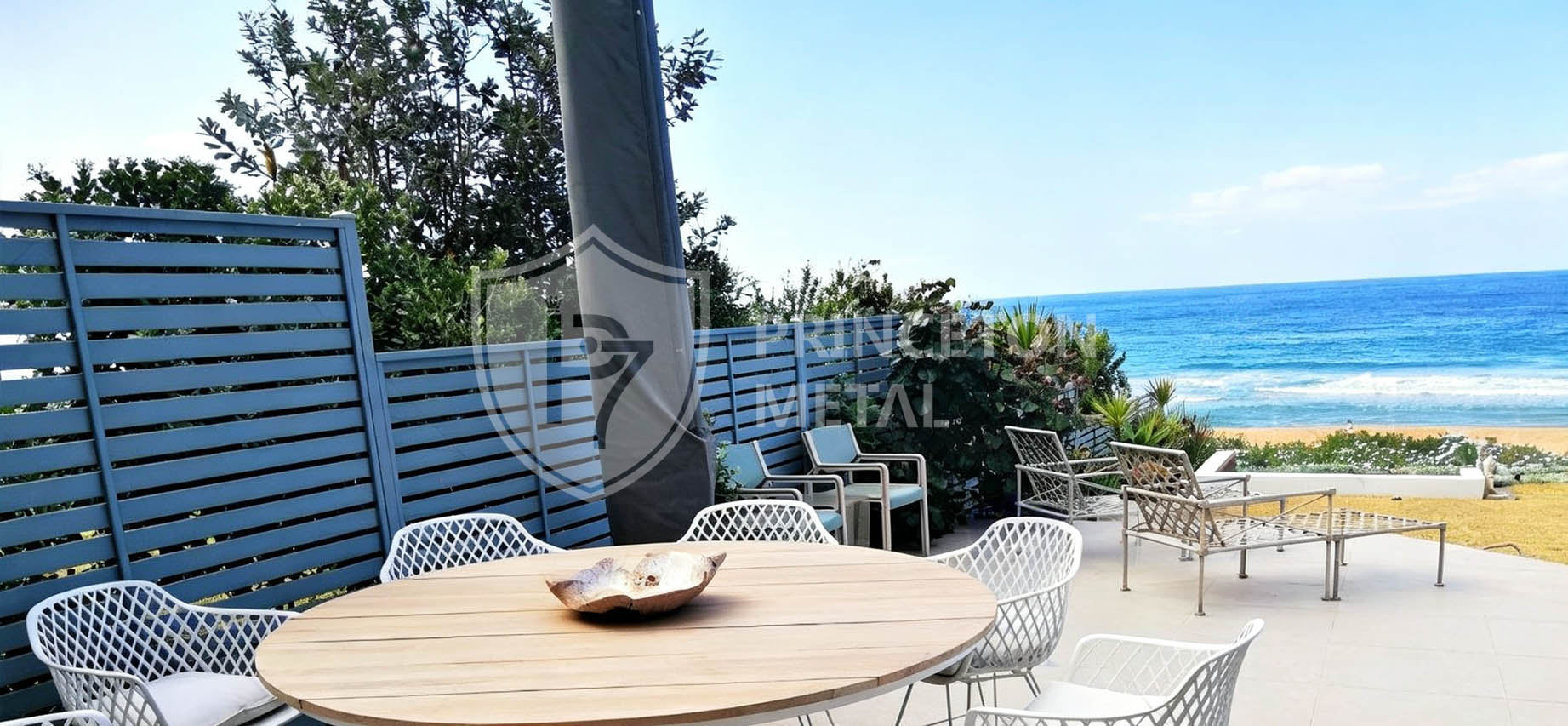
Pillar 1: Automated 9-Stage Chrome-Free Pretreatment
Powder coating bonds chemically to the conversion layer, not raw aluminium. In coastal C4/C5 zones, standard spray-washing fails. Quality fabrication demands automated 9-stage chrome-free conversion pretreatment. Acid etching, deoxidation, and zirconium passivation create an inert crystalline matrix that blocks chloride creep—even if the finish suffers minor on-site scratches.
Pillar 2: Class 2 Super-Durable Powder Chemistry
Standard AAMA 2603 polyesters degrade under Australia’s intense UV radiation. You must specify Class 2 Super-Durable Polyesters (meeting AAMA 2604, such as Dulux Duratec® or AkzoNobel Interpon® D2015). AAMA 2604 powders undergo 5 years of severe Florida weathering testing, ensuring polymer resistance to UV chalking and salt-spray.
Pillar 3: Edge Chamfering and 90–100µm+ Local DFT Build
Surface tension causes liquid powder to pull away from sharp 90-degree corners during curing, leaving cut edges under 25 µm. To prevent edge creep on coastal louvres and perforated facade panels, profiles must be deburred and radius-chamfered before coating, achieving 90–100 µm+ dry film thickness (DFT) across all critical edges.
3. Decoding AS 4312 Corrosivity & AAMA Warranty Tiers
Match your site's exact AS 4312 zone to the corresponding AAMA specification tier:
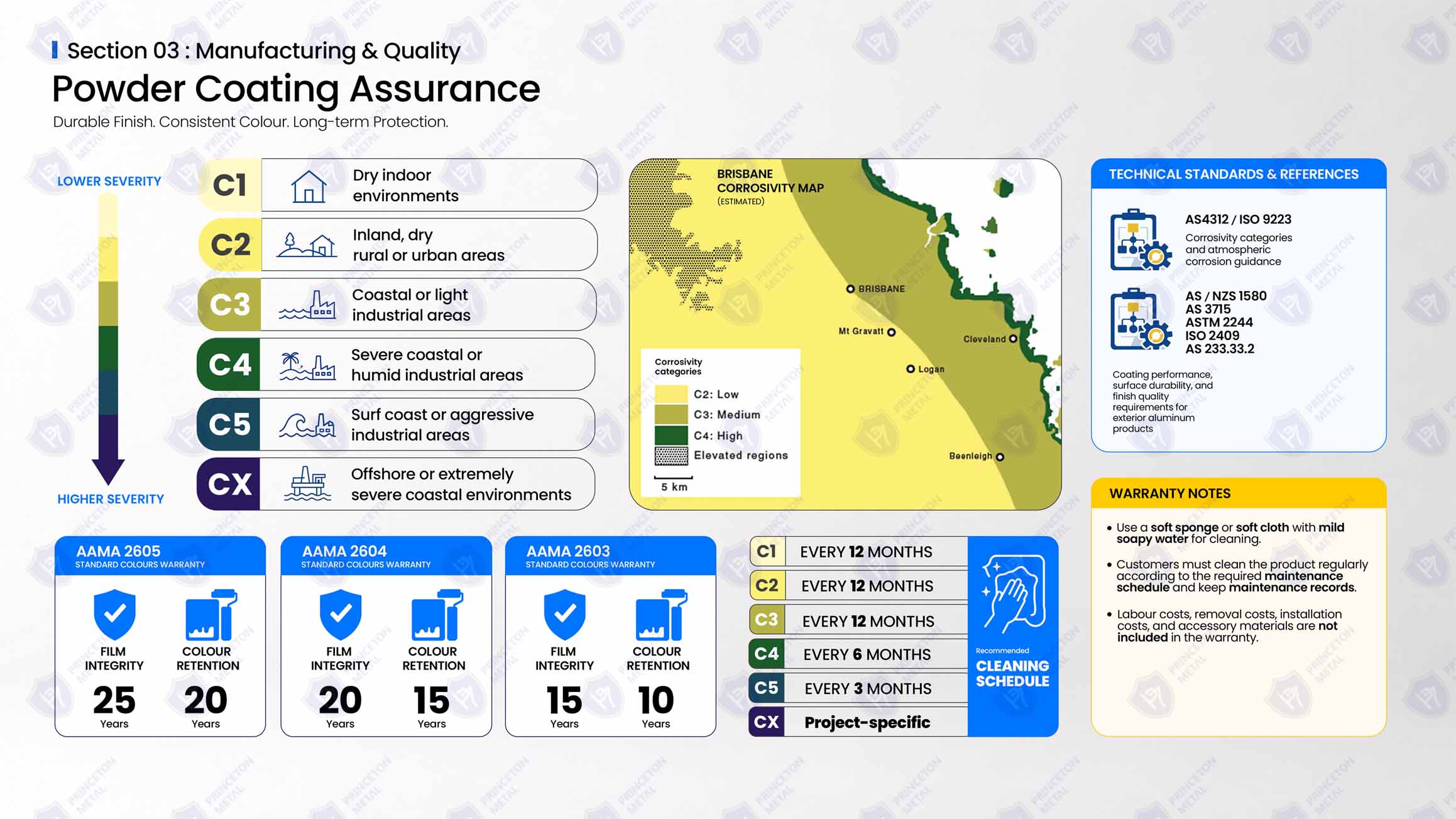
| Atmospheric Zone (AS 4312) | Environmental Exposure & Distance to Ocean | Required Coating Standard | Recommended Architectural Applications |
| C1 / C2 (Low) | Inland dry rural areas | AAMA 2603 | Interior trims, sheltered residential partitions |
| C3 (Medium) | 1 km to 10 km from sheltered coastal waters | AAMA 2604 (Class 2) | Urban multi-res balustrades, commercial fencing |
| C4 (High) | Within 1 km of open coastline | AAMA 2604 / AS 3715 | Coastal exterior louvres, screens, facade battens |
| C5 / CX (Extreme) | Direct oceanfront, breaking surf spray | AAMA 2605 | Beachfront high-rise facades, civic infrastructure |
4. How Princeton Metal Helps Manage Coastal Risks and Warranty Requirements
For aluminium fencing and screening projects in coastal Australia, product quality depends on more than material selection. At Princeton Metal, we focus on manufacturing precision, surface treatment, coating quality, and protective packaging to help customers manage coastal exposure risks and meet project requirements.
Integrated Manufacturing: Our manufacturing capabilities cover aluminium profile processing, fabrication, and coordinated pretreatment and powder-coating processes. Attention to cut edges, drilled holes, and weld areas helps reduce potential coating weaknesses in demanding coastal environments.
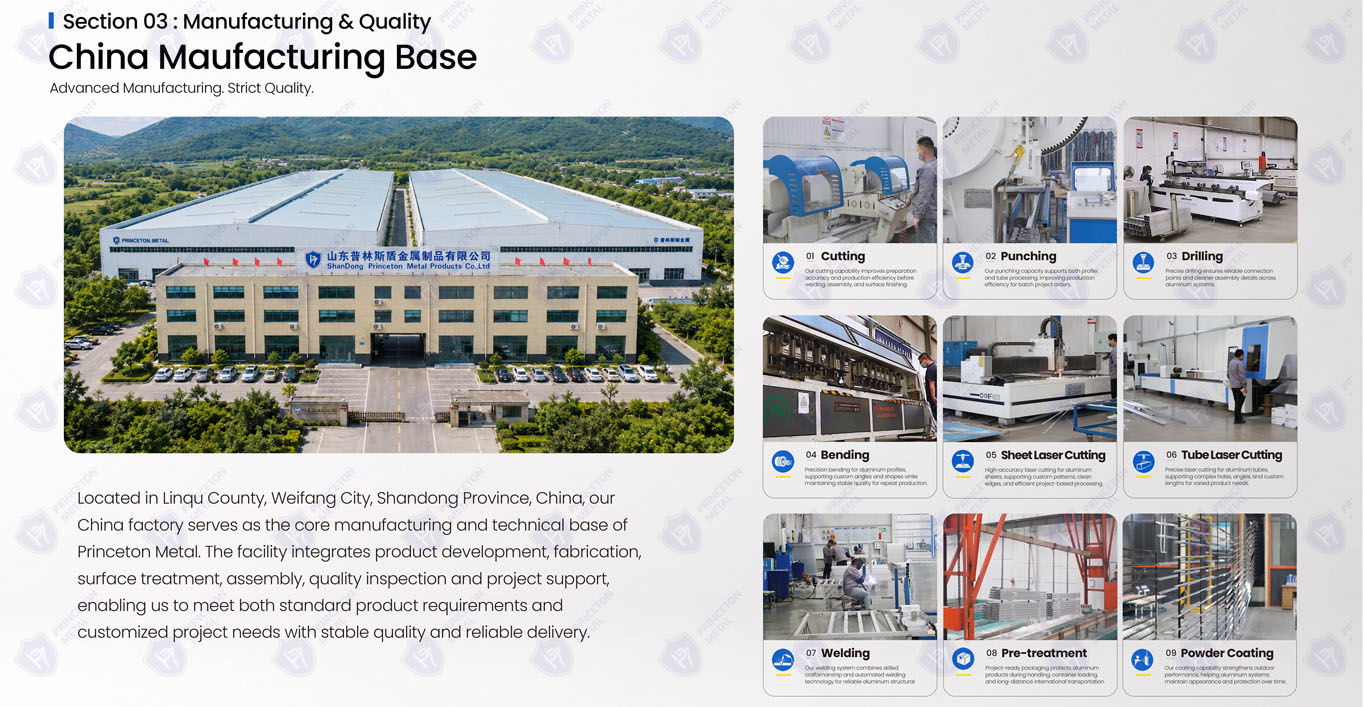
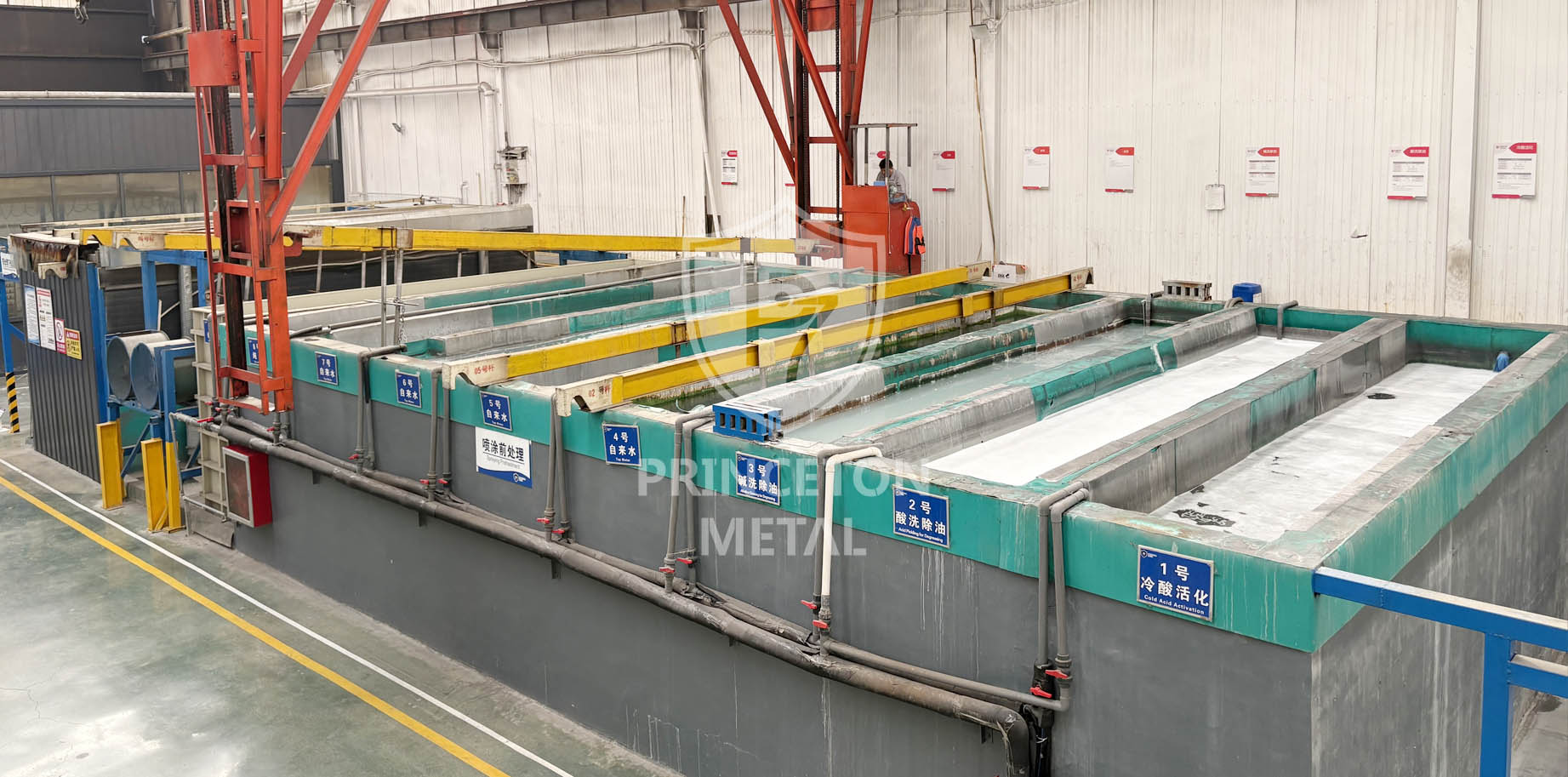
Automated 9-Stage Chrome-Free Pretreatment: Our automated nine-stage line prepares aluminium surfaces for powder coating through controlled cleaning, rinsing, and passivation processes. This supports consistent surface preparation and helps meet relevant environmental requirements.
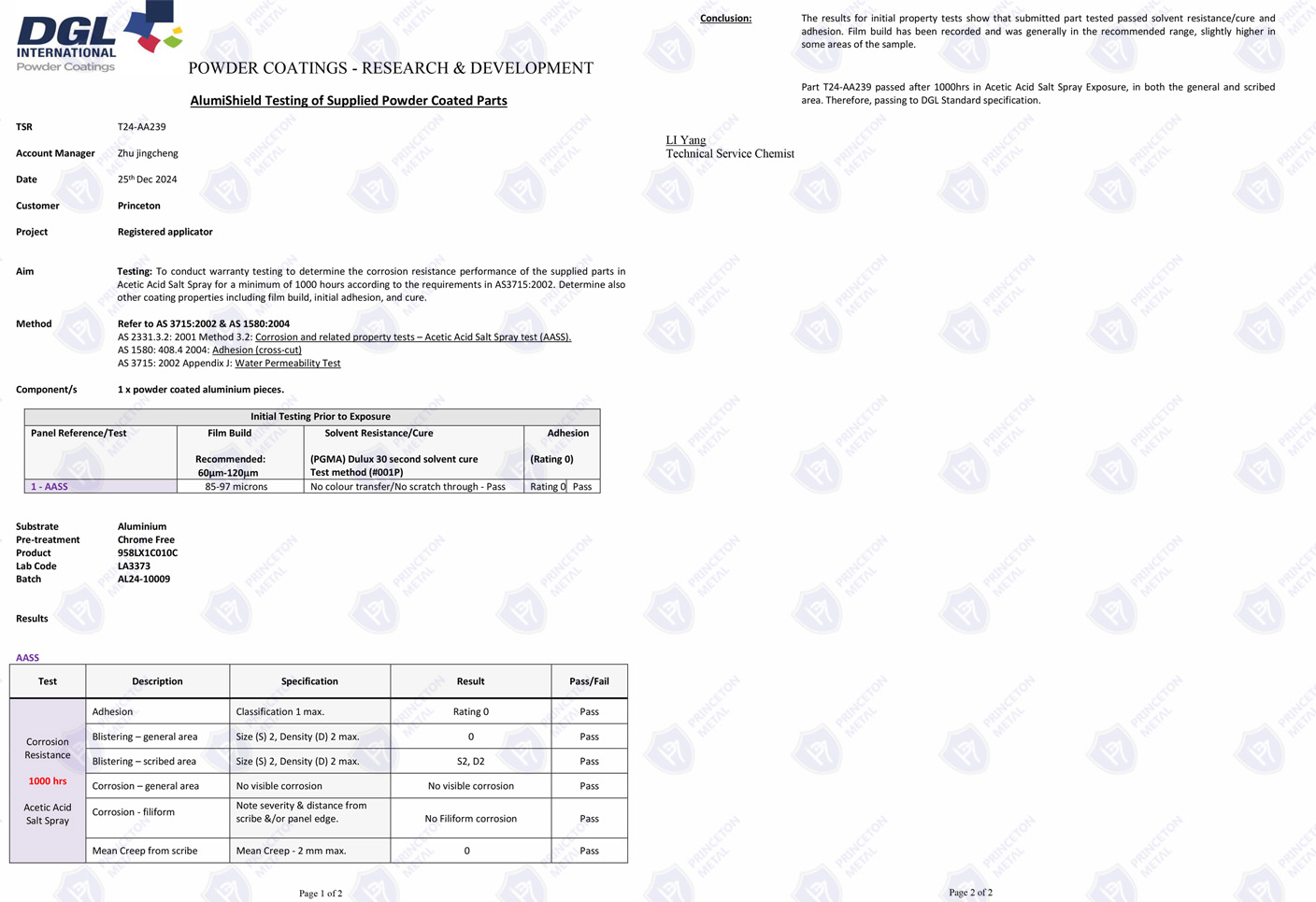
Suitable Powder-Coating Options: We can discuss AAMA 2604- and AAMA 2605-level coating options based on project exposure, colour requirements, and warranty expectations. Colorbond® colour matching can also be considered, subject to coating availability and the selected system. Actual warranty coverage depends on the product, application conditions, and applicable terms.
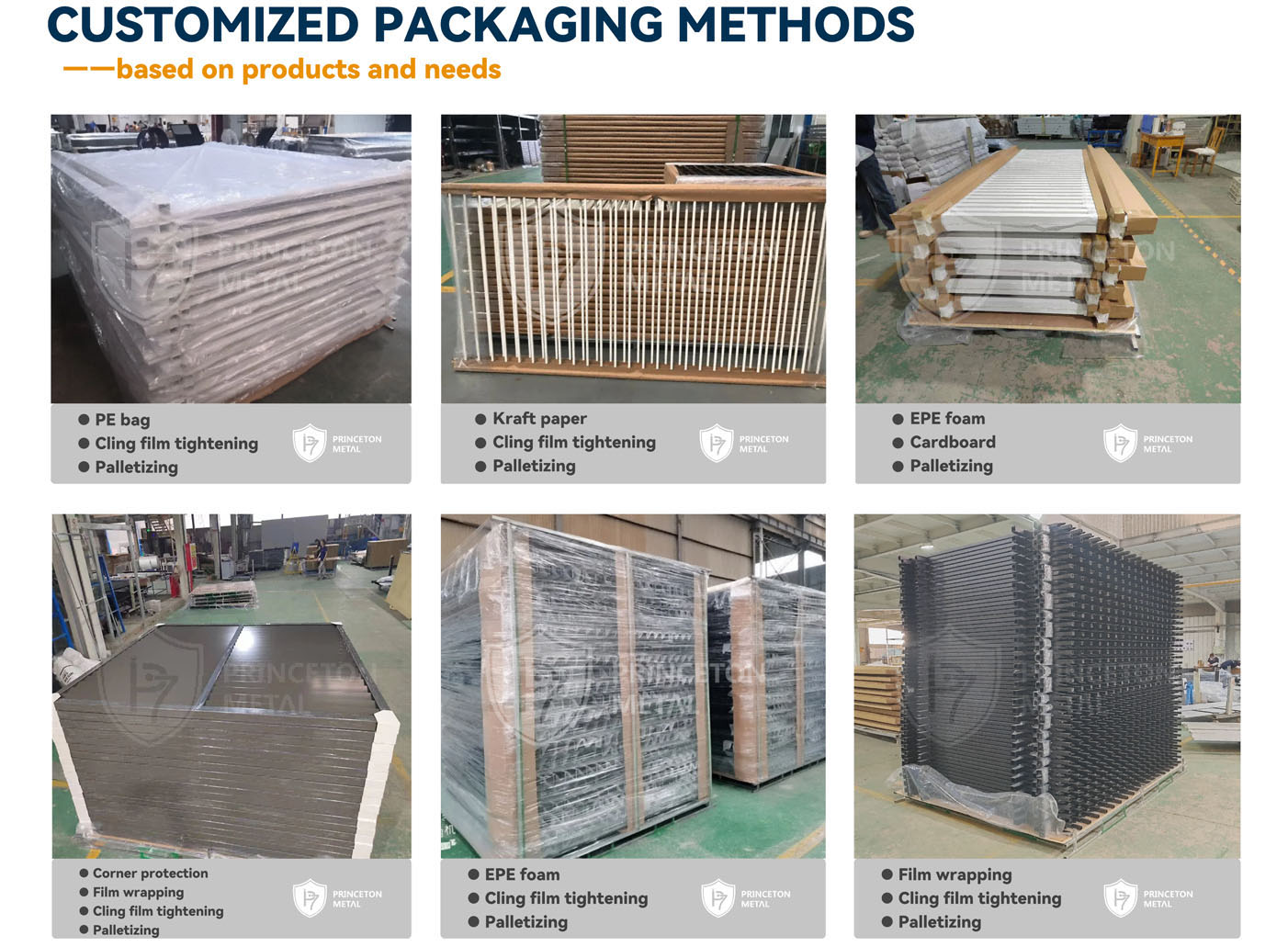
Protective Export Packaging: Foam-separated profiles and suitable crating options help protect finished surfaces during handling and international transportation, reducing the risk of scratches and transit damage.
Planning an Aluminium Project?
Send us your drawings, product specifications or project requirements to discuss a suitable manufacturing solution.
Tel: 0086-17616763451
WhatsApp: +86-17616763451
Email: sales@princetonmetal.com
Factory Address: NO.2788, Nanhuan Road, Linqu County, Weifang City, Shandong Province, China, 262600