

 Aug 25, 2026
 View:148
In construction and municipal projects, the choice of aluminum fencing directly impacts overall project quality, safety performance, and long-term maintenance costs. For distributors and engineering contractors, selecting the right supplier and product means lower after-sales risk, higher profit margins, and smoother project delivery.
As a company deeply rooted in the aluminum products industry, Shandong Princeton Metal Products Co., Ltd. combines years of experience serving global B2B clients to outline the key procurement decision points for aluminum fencing across five core dimensions: material and craftsmanship, surface treatment, structural design, customization capability, and delivery assurance.
Material and Craftsmanship: The Foundation of Long-Term Fence Performance
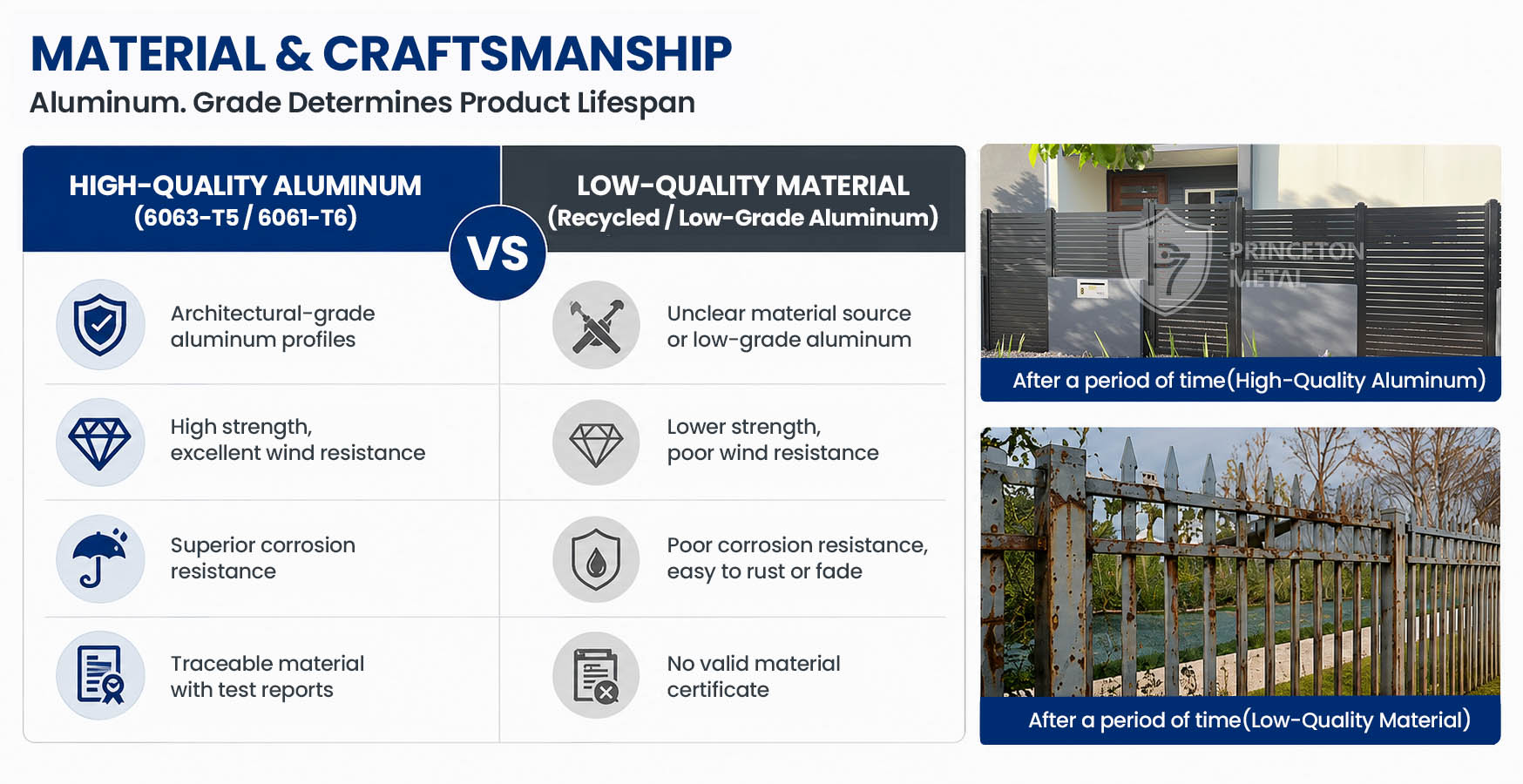
Aluminum alloy selection should be based on structural, fabrication and application requirements. Common options for architectural and outdoor aluminum products may include alloys and tempers such as 6063-T5 and 6061-T6, depending on the project. Inferior recycled aluminum or poorly controlled low-grade materials may reduce structural consistency, corrosion resistance and long-term durability, increasing the risk of deformation, cracking or premature failure over time.
Princeton's Practice: Our aluminum profiles are manufactured in strict accordance with"Aluminum Alloy Building Profiles" standards. We can supply 6063-T5, 6061-T6 and other grades and tempers according to specific project requirements. Material certificates and relevant test reports can be provided based on customer requirements, ensuring greater transparency and traceability of material information.
Surface Treatment: Choosing the Right Coating for Outdoor Conditions
The outdoor lifespan of an aluminum fence depends less on the aluminum itself than on whether the surface treatment matches the operating environment. Inland dry climates and coastal high-salt-spray zones demand completely different coating solutions. The wrong choice may show no obvious difference at delivery, but over time, fading, chalking and peeling can emerge, ultimately affecting the appearance and reputation of the finished project.
Surface treatment is also where "invisible shortcuts" most easily occur in the aluminum fencing supply chain. Wall thickness can be measured with calipers, dimensions verified with a tape measure — but pretreatment quality beneath the coating, the grade of powder used, and curing temperature control are all things invisible after delivery, yet they determine the fence's outdoor lifespan.
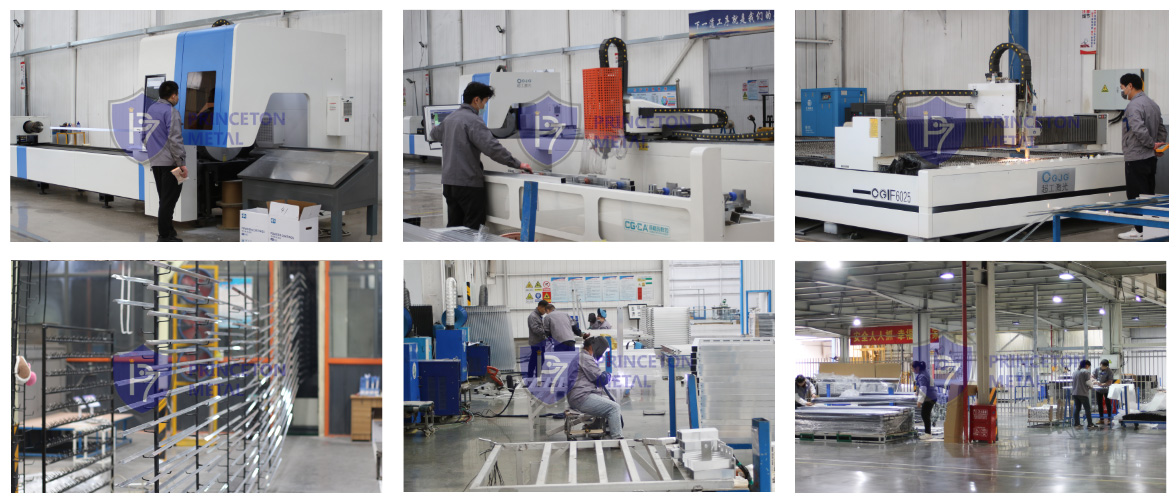
Princeton treats surface treatment as a core link in the quality chain that cannot be outsourced. The company operates an automated powder coating line, where the entire process — from pretreatment (degreasing → rinsing → passivation) to electrostatic spraying and high-temperature curing — is completed in-house. The value of an automated line lies in precision: spraying parameters (electrostatic voltage, powder output, line speed, curing temperature curve) are controlled by equipment rather than human judgment, minimizing batch-to-batch variation.
Structural Design: Where Safety Meets Installation Efficiency
The structural design of an aluminum fence ultimately comes down to two questions: "Will it hold up?" and "How fast can it go in?" Distributors and contractors evaluating options should focus on four dimensions:
1.Post wall thickness and spacing. Main posts form the load-bearing framework of the entire fence system. Appropriate wall thickness and post spacing should be determined based on factors such as fence height, profile design, wind load, installation conditions and applicable project requirements. These structural parameters should not be reduced simply to lower material costs.
2.Connection method. Exposed screws and surface-mounted connectors not only compromise visual integrity but are also prone to loosening and corrosion over time. Concealed connections or tamper-resistant designs offer clear advantages in both aesthetics and long-term security.
3.Modularity. A highly modular fence system means less on-site cutting, less adjustment, and a lower technical threshold for installation. For contractors, installation efficiency directly impacts labor costs. For distributors, modular products mean end customers can complete most of the installation themselves — significantly reducing after-sales support costs.
4.Wind Load and Site Conditions. Fence height, panel width, post spacing and foundation requirements should be evaluated according to the installation environment and applicable local requirements.
Princeton's fence systems follow these principles in structural design: posts and rails use concealed connection structures with a clean exterior free of exposed fasteners. The system is developed with a modular approach and high standardization coverage — on-site installation is primarily assembly-based, minimizing cutting and drilling.Installation drawings and packing lists can be provided based on specific customer requirements and project needs, while our technical team provides remote installation guidance to help contractors reduce rework and quality disputes caused by improper installation.
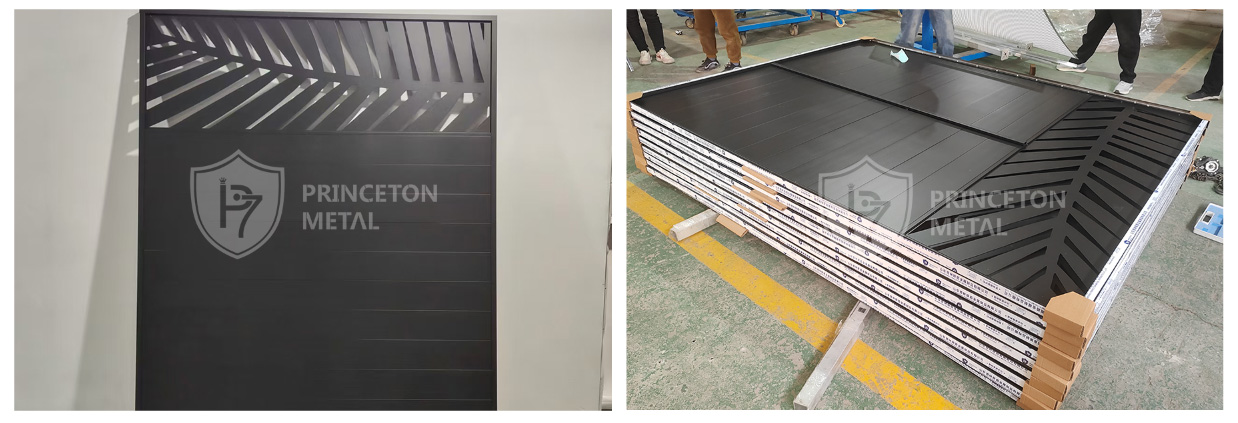
Customization Capability: From Standard Products to Project-Specific Solutions
In B2B procurement, customization capability is a key indicator of a supplier's core competitiveness. Different projects have varying requirements in height, color, style, and functionality.
For distributors, customization is not simply about changing dimensions or colors. It can also determine whether a fence system fits local market preferences, installation habits and product positioning.
Shandong Princeton Metal Products Co., Ltd. offers:
✅ Mold Development:On-site Mold Storage & Management tooling workshop capable of developing custom profile cross-sections based on client drawings, with a 15-20 day development cycle
✅ Flexible Dimensions: Standard fence heights are available in 1.2m, 1.5m, and 1.8m, with customized heights available based on specific project requirements.
✅ Combined Solutions: Aluminum fencing can be supplied together with aluminum gates, railings, and curtain wall grilles — one-stop procurement reduces logistics and communication costs.
Delivery Assurance: Can Your Supplier Deliver Consistently?
For distributors and contractors, product quality is only one part of the procurement decision. A reliable supplier must also be able to deliver products consistently, package them properly, and provide the documentation required for international projects.
Before placing an order, buyers should evaluate:
(1)Production capacity
(2)Quality consistency
(3)Packaging standards
(4)Lead time management
(5)Export documentation
(6)Order tracking and communication
Princeton's Practice: Our products are exported to more than 50 countries and regions, including North America, Europe, Australia and Southeast Asia. We support product documentation, packaging requirements and export-related materials based on customer and market requirements. From production coordination and quality inspection to packaging and shipment preparation, our goal is to help distributors and project buyers manage orders more efficiently and reduce avoidable delivery risks.
Looking for a Reliable Aluminum Fence Supplier?
Choosing an aluminum fence supplier is not only about comparing prices. The right partner should understand your product requirements, project conditions, customization needs and long-term supply expectations.
Shandong Princeton Metal Products Co., Ltd. provides standard and customized aluminum fencing solutions for distributors, contractors and project buyers.
Whether you have a project drawing, product specification, reference image or a new product idea, our team can help evaluate your requirements and explore a suitable solution.
Send us your inquiry, drawing or product requirements, and we will provide a preliminary solution within 48 hours.