


How to choose aluminum pool fencing for residential and commercial projects
 Oct 21, 2026|
 View:30
Choosing aluminum pool fencing comes down to five factors: safety code compliance, durability, design, cost, and the different demands of residential versus commercial sites. You weigh these factors in a different order for a backyard pool than for a public aquatic facility. Safety always leads, and the stakes are clear. Four-sided isolation fencing cuts a child's drowning risk by about 83%. Durability, design, and cost then shape the final choice. This post gives you a practical framework you can apply to either project type. You will learn how each factor shifts between a home and a commercial site.
Key Takeaways
Safety comes first: choose a fence that meets pool safety codes to protect children from drowning.
Aluminum fencing resists rust and needs little maintenance, saving you time and money over the years.
For home pools, pick a style that matches your house and budget while keeping safety in mind.
Commercial projects need stronger aluminum and must follow stricter safety standards for public use.
Compare total costs over the fence's life, not just the purchase price, to make a smart choice.
Why aluminum pool fencing is a viable option
Strengths for pool environments
Aluminum pool fencing resists rust and corrosion, so it holds up well in humid, chlorine-rich pool settings. Salt air near coastal pools does not attack the metal the way it attacks iron. A powder-coated finish adds another layer of protection and keeps maintenance low. You won't need to repaint or seal it often. A quick rinse with a garden hose handles most cleaning. Aluminum also stays 10–20°F cooler than steel in direct sun, which matters for bare feet and hands near a pool deck. The metal is lightweight, yet it holds its shape under normal use.
Specification | Pool-ready feature |
|---|---|
Barrier height | At least 5 feet, no footholds below 4 feet |
Picket spacing | No more than 4 inches (standard panels: 3.75 in) |
Gates | Self-closing, self-latching from any open position; latches at 54 in or higher |
Fasteners | Stainless steel |
These features make aluminum a practical barrier for family pools and public facilities alike. The finish resists chalking and fading, so the fence keeps its look through many seasons. You get a barrier that works hard without demanding much work from you.
Where aluminum fits best
Aluminum pool fencing suits residential, commercial, and industrial properties. Common applications include:
Hotel pool decks
Apartment complexes
Office parks
HOA communities
Pool enclosures
Security perimeters with anti-climb panels
Dumpster enclosures and perimeter beautification
The same product family covers all these uses with different panel styles and gate hardware. A warehouse yard may need a tall security perimeter, while a community pool may need a low, open design.
Style, function, and finish should match the property's needs. Ornamental designs with decorative finials and scrollwork suit appearance-first projects. Residential settings often use pool-code compliant systems for sloped yards. Commercial and industrial sites pair the same systems with heavy-duty gate hardware and coordinated accessories. A municipal facility may prioritize anti-climb panels, while a backyard project may favor a curved or perforated look. Match the finish to the surrounding architecture, and the fence will look like part of the plan.
Choosing aluminum pool fencing for residential projects
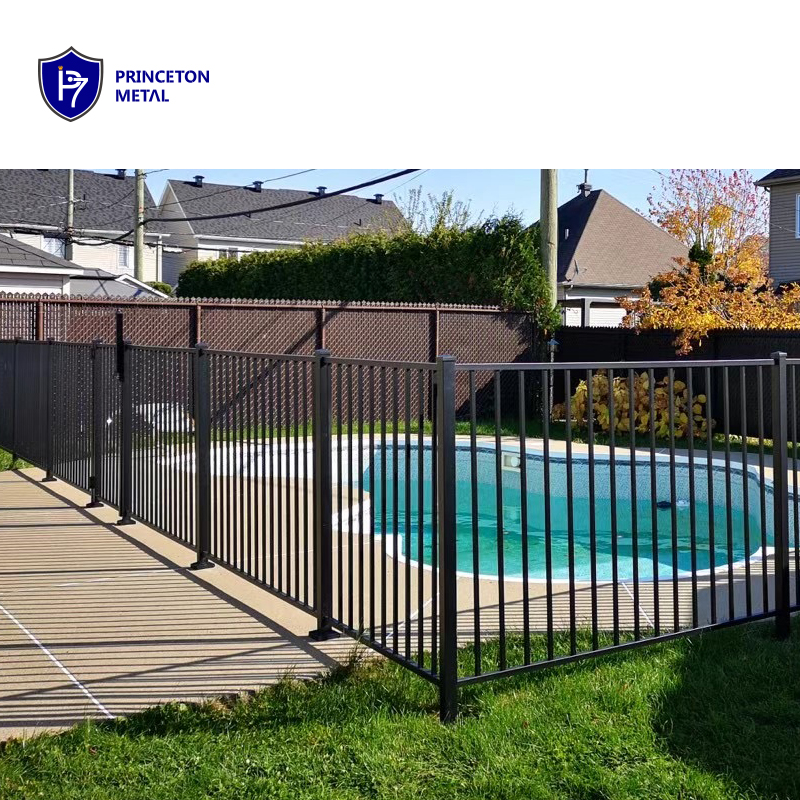
Safety, style, and budget
Safety comes first for a backyard pool. The ICC model code sets a minimum barrier height of 48 inches, measured from the finished grade on the exterior side. Your gate hardware matters just as much as the height. The gate must close on its own from any open position, not just from fully open. The latch must engage automatically when the gate closes. The gate should swing away from the pool, so a child leaning on it cannot push it toward the water. If the latch release sits below 54 inches, it must be on the pool side and at least 3 inches below the top of the gate. Always confirm your local code before you order, because some jurisdictions require more.
Jurisdiction / Standard | Minimum Barrier Height |
|---|---|
ASTM F1908 (federal baseline) | 48 in. |
ISPSC / ICC model code | 48 in. |
Florida (FBC Chapter 4) | 48 in. |
California (HSC 115922, new construction) | 60 in. |
Arizona (AAC R18-5-224) | 60 in. |
Residential projects usually use lighter aluminum extrusions. This keeps material costs lower without giving up code compliance. Princeton's Aluminum Pool Areas line covers this need well. The range includes perforated, flat top tubular, and curved designs, plus custom gates. Every panel carries an AAMA 2604 or 2605 powder-coated finish. You can customize hole patterns, panel sizes, colors, and heights to match your home's architecture. A perforated panel balances privacy, airflow, and visibility. A flat top tubular design prevents climbing and suits most backyard decor. A curved run adds a polished look to an irregular pool deck.
Maintenance and long-term value
A powder-coated aluminum fence needs very little upkeep. The electrostatically applied, heat-cured coating bonds to the metal, so the finish holds through sun, salt air, and pool splash. You wipe it down now and then. You never repaint, seal, or apply chemical treatments. Compare that with wrought iron, which needs recoating every few years in humid or coastal climates, or mesh, which you replace seasonally. Aluminum typically lasts 20 years or more. The powder coat holds its color for 5 to 10 years, depending on whether it meets AAMA 2604 or 2605. That low upkeep adds up to real savings over the fence's life. A well-chosen aluminum pool fencing system also lifts curb appeal, and many homeowners treat it as an investment rather than an expense.
Choosing aluminum fencing for commercial projects
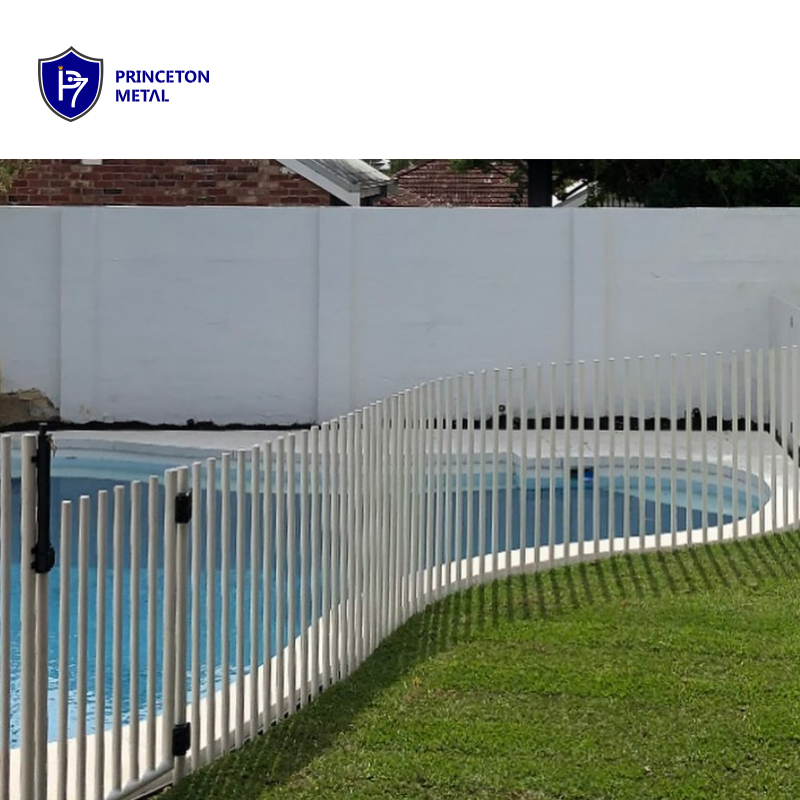
Durability, security, and compliance
Commercial sites demand thicker aluminum extrusions than a backyard job. Higher traffic, heavier gates, and public liability raise the structural bar. Your fence must also meet recognized pool safety standards, such as AS 1926.1. Verify the applicable local and international codes before you approve production drawings.
AS 1926.1 Requirement | Benchmark | What It Means for Your Aluminum Fence |
|---|---|---|
Effective barrier height | 1200 mm minimum widely used | A nominal 1200 mm panel may fall short if ground rises beside it |
Gaps between components | 100 mm maximum clear opening | Specify actual clear openings, not nominal tube centers |
Non-climbable zone | Continuous 900 mm zone commonly required | Keep horizontal members and decorative elements out of this zone |
Gates, hinges, latches | Self-close and self-latch automatically; 2024 revision updates testing cycles | Specify frame, posts, hinges, and latch as one complete system |
Ground level and slopes | Height measured from finished ground level | Sloped sites may need stepped panels or custom post lengths |
Confirm which edition applies to your jurisdiction. AS 1926.1:2024 is the latest edition, yet some jurisdictions still reference the 2012 edition. Material choice alone does not guarantee compliance. The completed, installed barrier must satisfy every dimensional, structural, and operational requirement.
Security starts with climb resistance. Install fences at 54 inches to meet gate latch height rules. Configure picket spacing to block a 4-inch-diameter sphere. Position horizontal rails on the pool side to remove exterior footholds. Slim vertical pickets meet code without blocking sightlines, and the aluminum construction delivers an upscale look with zero rust.
Complex layouts need more than a catalog panel. Ask for engineering consultation and CAD deepening on sloping terrain, tight corners, and custom gate openings. A lightweight gate on an unstable post can misalign and fail to latch, so treat the gate as a system, not a part.
Cost-effectiveness at scale
Judge commercial aluminum pool fencing by total ownership cost, not sticker price. Add material cost, installation, and maintenance over 20 years. That sum is your real comparison figure. Aluminum's higher upfront cost can shrink once you factor in savings on repairs, repainting, and replacement. Enhanced perimeter security may also support property value and insurance outcomes.
Purchase price represents only 40–60% of total 15-year ownership cost across fencing materials.
A 25-year lifecycle framework tells the same story. One logistics hub chose a low-cost wood picket fence under budget pressure. Warping and insect damage brought recurring repairs within five years and full replacement by year ten. The initial savings vanished. Discount future costs to present value, and the question shifts from what is cheapest today to what is most cost-effective over the full service life.
Comparing aluminum with other pool fencing materials
Performance and compliance
Each material fits a different project. Compare them on the dimensions that matter for a pool barrier.
Dimension | Aluminum | Vinyl | Wrought Iron / Steel |
|---|---|---|---|
Pool-code compliance | Standardized panels with consistent 2–4 in picket spacing comply naturally | Often needs costly modification to meet spacing and height rules | Often needs costly modification; decorative elements can create climbable footholds |
Durability | Powder coating resists fading; dents without cracking | Degrades under UV; cracks on impact | Very strong and impact-resistant; needs coating to prevent rust |
Corrosion | Superior corrosion resistance, especially in humid climates | No corrosion risk, yet deteriorates faster in chlorine-heavy settings | Rust-prone without protective coating |
Maintenance | Virtually none beyond occasional cleaning | Annual inspection and cracked-panel replacement | Rust inspection and repainting every few years |
20-yr annual cost | $0–200 | $100–300 | $200–500 (steel) |
Vinyl suits budget-focused projects in mild climates. Wrought iron suits period architecture where strength and ornament matter most. Aluminum pool fencing sits between them on upfront price and wins on upkeep.
Climbability is the most important safety difference between pool fence types. Metal fences often have horizontal rails or decorative crossbars that act like ladder rungs, and many pool safety organizations consider traditional metal fencing climbable. ASTM standard F2286 specifically addresses climbability.
Practical steps to your final choice
Start with the project's primary purpose. A four-sided isolation barrier around a home pool serves a different job than a perimeter fence around a commercial deck. Write down the layout, gate count, and site conditions before you price anything.
Next, read your local code and underline the exact measurements: minimum height, gate self-closing and self-latching rules, and maximum bottom gaps. Check your city or county building department website and any HOA guidelines. Call local officials if the wording is unclear.
Finally, gather written quotes. Ask each supplier to confirm the proposal reflects code and HOA requirements, including gates and timeline. Compare the quotes side by side, then choose.
Your choice starts with the project type. A backyard pool and a commercial deck carry different demands, so match the fence to the site before anything else. Confirm local pool safety code compliance next. Height, gate hardware, and clear openings decide whether your barrier passes inspection. Then balance durability, design, and cost against the fence's full service life.
Use the practical steps to move from research to a confident purchase. Assess your needs, check the regulations, and gather written quotes. A well-chosen aluminum pool fencing system protects your pool area for decades, keeps its finish, and asks almost nothing of you beyond an occasional rinse.
FAQ
How tall does a pool fence need to be?
The ICC model code sets a 48-inch minimum, measured from finished grade on the outside. Some states go higher, such as California and Arizona at 60 inches. Check your local code before ordering, because your jurisdiction may exceed the baseline.
What gate hardware does a pool barrier require?
The gate must close and latch on its own from any open position. It should swing away from the pool. If the latch release sits below 54 inches, place it on the pool side and at least 3 inches below the gate top.
How long does a powder-coated aluminum fence last?
Most aluminum fences last 20 years or more. The powder coat holds color for 5 to 10 years, depending on whether it meets AAMA 2604 or 2605. Upkeep is minimal: an occasional rinse, no repainting.
What changes between a residential and a commercial project?
Residential jobs typically use lighter extrusions to control cost. Commercial sites need thicker aluminum, heavier gate hardware, and compliance with standards such as AS 1926.1. Complex layouts and slopes may call for engineering consultation and CAD deepening.
How do I compare quotes fairly?
Ask each supplier to confirm the proposal meets your local code and HOA rules, gates included. Compare total ownership cost over the fence's life, not just the sticker price. Then weigh durability, design, and maintenance against your budget.